Introduction
Search is changing faster than ever.
For years, businesses focused primarily on ranking their websites on Google and other traditional search engines. The objective was straightforward: choose relevant keywords, create useful content, build authority, optimize the website, and earn organic traffic.
In 2026, that strategy still matters. However, the search landscape has expanded.
People increasingly ask AI-powered systems questions instead of browsing through pages of traditional search results. Platforms such as ChatGPT, Google AI Overviews, Gemini, Perplexity, and other answer-focused systems can summarize information, compare businesses, recommend products, and provide direct answers.
That shift has created a new opportunity for businesses: AI search visibility.
An AI SEO agency helps businesses adapt to this changing environment by combining traditional search engine optimization with strategies designed for AI-generated answers. Depending on the agency, this may include technical SEO, content optimization, entity optimization, Answer Engine Optimization (AEO), Generative Engine Optimization (GEO), digital PR, authority building, and AI visibility tracking.
The important point is that AI SEO does not mean abandoning traditional SEO. Strong technical foundations, useful content, authority, and trustworthy information remain essential. Current industry discussions increasingly describe GEO and AEO as extensions of strong SEO fundamentals rather than completely separate replacements.
This guide explains what an AI SEO agency does, how AI search works, which services matter, how to choose an agency, and what businesses should expect from an AI-focused SEO strategy in 2026.
What Is an AI SEO Agency?
An AI SEO agency is a digital marketing agency that uses artificial intelligence, traditional SEO techniques, and AI-search optimization strategies to improve a brand’s online visibility.
The goal is no longer limited to ranking a webpage for a particular keyword.
Instead, the broader goal is to make a brand:
- Discoverable in traditional search
- Understandable to search engines
- Visible in AI-generated answers
- Citable by answer engines
- Recognized as an authoritative entity
- Relevant for conversational searches
- Competitive across multiple search experiences
AI SEO can therefore combine traditional SEO with AEO, GEO, entity optimization, content strategy, technical optimization, and visibility monitoring.
Some current industry definitions use AI SEO as an umbrella term that includes traditional SEO, GEO, and AEO.
Why AI Search Matters in 2026
The biggest change is the way users interact with search.
Traditional search generally presents a list of results. AI search can synthesize information from multiple sources and provide a conversational response.
For example, instead of searching:
“best accounting software for small business”
a user may ask:
“Which accounting software is best for a small business with five employees, and why?”
The second query is more conversational and contains more context.
An AI system may respond with a short list of recommendations and supporting information.
That means businesses increasingly need to think beyond individual keywords.
They need to understand:
- Questions
- Topics
- Entities
- Context
- Comparisons
- User intent
- Brand authority
- Supporting evidence
An AI SEO strategy addresses these broader search behaviors.
AI SEO vs Traditional SEO
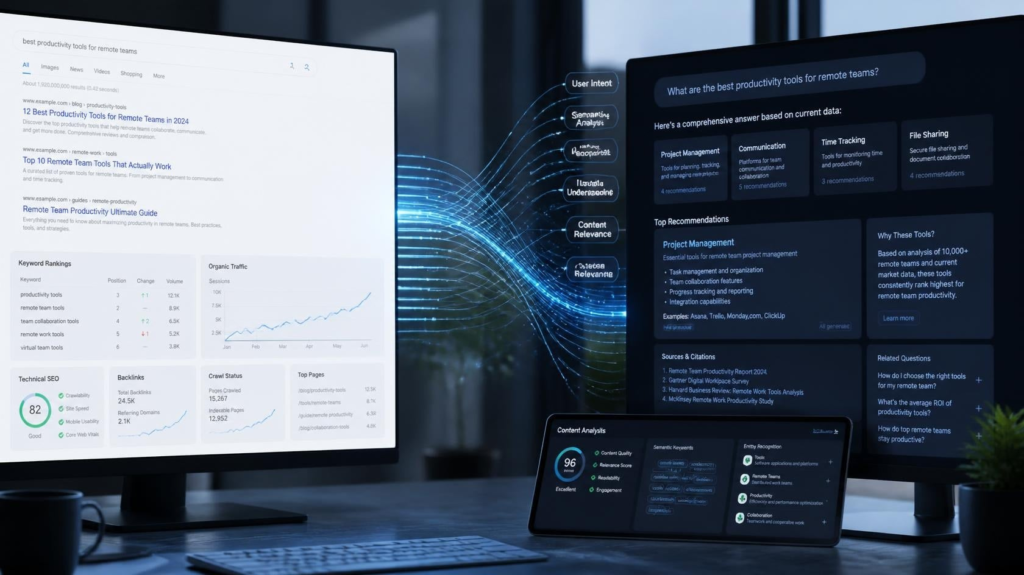
AI SEO and traditional SEO are closely connected, but their objectives can differ.
Traditional SEO
Traditional SEO generally focuses on:
- Organic rankings
- Keyword visibility
- Search traffic
- Technical performance
- Backlinks
- On-page optimization
- Search intent
The primary objective is to help pages appear prominently in search results.
AI SEO
AI SEO adds another layer.
It focuses on:
- AI-generated answers
- Brand mentions
- AI citations
- Conversational queries
- Entity recognition
- Answer-ready content
- AI search visibility
- Generative search experiences
A strong AI SEO strategy should therefore build on traditional SEO rather than replacing it.
If a website has poor technical performance, weak content, little authority, and unclear information, simply adding AI-related terminology will not solve the underlying problems.
What Does an AI SEO Agency Do?
The exact services differ between agencies, but a comprehensive AI SEO agency may provide several important areas of optimization.
1. AI SEO Audit
The first step should usually be understanding the current position of a website.
An AI SEO audit may examine:
- Technical SEO
- Organic rankings
- Existing content
- Search intent coverage
- Internal linking
- Structured data
- Brand mentions
- Authority signals
- Competitor visibility
- AI search presence
An agency can then identify gaps and prioritize opportunities.
2. Technical SEO Optimization
Technical SEO remains one of the foundations of AI search visibility.
Search engines and AI systems need accessible, understandable information.
Important technical areas include:
Crawlability
Search engines need to discover important pages.
Agencies may review:
- Robots.txt
- XML sitemaps
- Internal links
- Crawl errors
- Redirects
- Canonical URLs
Website Speed
Fast websites provide a better user experience and create a stronger technical foundation.
Optimization may involve:
- Image compression
- Code optimization
- Caching
- JavaScript improvements
- Server performance
- Core Web Vitals
Mobile Optimization
Because mobile search remains important, websites should provide a consistent experience across devices.
A responsive design should make content easy to:
- Read
- Navigate
- Interact with
- Search
- Convert
3. AI-Optimized Content Strategy
Content remains at the center of SEO.
But AI search creates an additional requirement: content should be easy to understand, extract, summarize, and cite.
An AI SEO agency may restructure content around specific questions and entities rather than creating articles based solely on keyword density.
Good AI-ready content should be:
- Clear
- Accurate
- Well structured
- Specific
- Comprehensive
- Easy to scan
- Supported by credible information
Answer-Focused Content
One useful approach is to answer important questions directly.
For example:
What Is AI SEO?
A concise definition should appear near the beginning of the relevant section.
Then the article can expand with:
- Examples
- Benefits
- Implementation
- Best practices
- Limitations
- FAQs
This structure serves both human readers and systems that need to identify direct answers.
4. Answer Engine Optimization (AEO)
Answer Engine Optimization, commonly abbreviated as AEO, focuses on improving the likelihood that content will be surfaced as an answer in answer-oriented search experiences.
AEO can overlap with:
- Featured snippets
- Voice search
- AI Overviews
- Conversational search
- AI assistants
The underlying principle is simple:
Make information easy to understand and easy to retrieve.
Current AEO resources describe the discipline as optimizing content and brand signals so AI systems can select and present the information in generated answers.
How AEO Can Improve Content
An agency may optimize pages using:
- Direct answers
- Question-based headings
- Concise definitions
- Lists
- Tables
- FAQs
- Structured content
- Clear terminology
Instead of burying the answer inside a long paragraph, the page should make important information easy to identify.
5. Generative Engine Optimization (GEO)
Generative Engine Optimization, or GEO, focuses on improving a brand’s visibility within generative AI systems.
The goal is not simply to rank a webpage.
The broader goal is to increase the likelihood that a brand or source is:
- Mentioned
- Recommended
- Referenced
- Cited
- Included in AI-generated summaries
GEO is closely related to AEO and AI SEO. Current industry resources often treat these disciplines as overlapping areas of AI-search optimization.
6. Entity Optimization
Entity optimization is becoming increasingly important.
Search engines need to understand who or what a business is.
For example, a company might have:
- A brand name
- Founder
- Products
- Services
- Locations
- Industry
- Reviews
- Social profiles
- Business listings
- Press mentions
When these signals are consistent across the web, it becomes easier for search systems to understand the entity.
An AI SEO agency may therefore work on:
- Brand consistency
- Organization schema
- About pages
- Author information
- Business profiles
- Industry references
- External mentions
This helps create a clearer digital identity.
7. Digital PR and Authority Building
AI systems need reliable information.
Authority therefore remains important.
A strong AI SEO strategy may include digital PR and editorial link building to increase the number and quality of credible references to a brand.
Potential strategies include:
- Digital PR campaigns
- Expert contributions
- Industry publications
- High-quality guest posts
- Original research
- Data-driven content
- Editorial mentions
- Relevant backlinks
The objective should not be obtaining as many links as possible.
Instead, focus on relevance, credibility, context, and editorial quality.
8. Brand Mentions and Online Reputation
AI systems may use information from many sources.
That means your website is not the only place where your brand needs to be represented accurately.
Businesses should also consider:
- Industry directories
- Review platforms
- News publications
- Professional profiles
- Social platforms
- Partner websites
- Relevant communities
Consistency matters.
If one source describes a company differently from another, it can create confusion around the brand entity.
9. Structured Data and Schema Markup
Structured data gives search engines additional information about a webpage.
Depending on the page, relevant schema types may include:
- Organization
- Article
- Product
- FAQ
- LocalBusiness
- Person
- Review
- Breadcrumb
Schema should be accurate and relevant.
It should not be used to manipulate search results by adding information that does not exist on the page.
A technically clean implementation can help search engines better understand the content and entities represented on a website.
10. AI Search Visibility Tracking
Traditional SEO reporting often focuses on:
- Rankings
- Traffic
- Impressions
- Clicks
- Conversions
AI SEO requires additional measurements.
An agency may track:
Brand Mentions
How often does your brand appear in responses to relevant prompts?
Citation Frequency
How frequently is your website or content cited?
Share of Voice
How often does your brand appear compared with competitors?
Prompt Coverage
For how many important customer questions does your brand appear?
Sentiment and Context
When your brand is mentioned, is it presented positively and accurately?
These metrics can help businesses understand whether their AI visibility is improving.
AI SEO for Different Types of Businesses
AI search optimization can be valuable across many industries.
SaaS Companies
SaaS businesses can optimize for queries such as:
- Best project management software
- Best CRM for startups
- Alternatives to specific software
- Software comparisons
- Pricing questions
Detailed comparison pages and product documentation can be particularly useful.
eCommerce Businesses
eCommerce brands can focus on:
- Product comparisons
- Buying guides
- Product attributes
- Reviews
- FAQs
- Category pages
Clear product information helps users and search systems understand what is being sold.
Local Businesses
Local companies can optimize for conversational searches such as:
“Best dentist near me”
or:
“Which restaurant has the best vegetarian options nearby?”
Local SEO fundamentals remain important, including accurate business information, reviews, location pages, and authoritative local references.
B2B Companies
B2B businesses can build authority through:
- Industry reports
- Expert guides
- Research
- Case studies
- White papers
- Detailed service pages
B2B buyers often perform extensive research before contacting a company, making informational visibility particularly valuable.
How to Choose the Right AI SEO Agency
Not every company advertising AI SEO provides the same service.
Because the industry is relatively new, businesses should evaluate agencies carefully.
Look for Real SEO Expertise
An agency should understand:
- Technical SEO
- Content strategy
- Keyword research
- Search intent
- Link building
- Analytics
- Website architecture
AI search optimization should complement these fundamentals.
Ask About Their AI Search Methodology
Don’t simply ask:
“Do you offer AI SEO?”
Ask:
- Which AI platforms do you monitor?
- How do you measure AI visibility?
- How do you identify target prompts?
- How do you improve citation opportunities?
- How do you track competitors?
- How often do you report results?
Specific answers are more useful than marketing buzzwords.
Request Transparent Reporting
A good agency should explain what is being measured.
Reports might include:
- Organic traffic
- Keyword rankings
- AI mentions
- Citation changes
- Content improvements
- Technical issues
- Authority growth
- Conversions
Avoid agencies that promise guaranteed AI recommendations or guaranteed placement in AI-generated answers.
AI systems are dynamic, and no legitimate agency can control every generated response.
Red Flags to Avoid
Some warning signs deserve attention.
Guaranteed AI Rankings
No agency can guarantee that ChatGPT, Gemini, Perplexity, or another AI system will recommend a brand for every query.
Massive Automated Content
Publishing hundreds of generic AI-generated articles is not the same as having an effective AI SEO strategy.
Keyword Stuffing
Repeating “AI SEO agency” dozens of times will not make a page more authoritative.
Low-Quality Backlinks
Large quantities of irrelevant links can create more risk than value.
No Measurement System
If an agency cannot explain how it measures progress, it is difficult to evaluate its performance.
AI SEO Best Practices for 2026
Businesses can begin improving their AI search visibility with a practical framework.
Step 1: Build a Strong Technical Foundation
Fix:
- Crawl errors
- Broken links
- Slow pages
- Mobile issues
- Indexing problems
Step 2: Identify Important Customer Questions
Research what customers ask before buying.
Turn those questions into:
- Guides
- FAQs
- Comparison pages
- Tutorials
- Service content
Step 3: Strengthen Brand Authority
Earn relevant mentions through:
- PR
- Expert content
- Partnerships
- Editorial links
- Original research
Step 4: Improve Entity Signals
Make sure your:
- Brand name
- Company description
- Contact details
- Services
- Locations
- Author information
are consistent.
Step 5: Monitor AI Visibility
Track important prompts regularly and compare your presence with competitors.
Step 6: Keep Updating
AI search changes rapidly.
Review important content regularly and update outdated information, examples, statistics, and references.
Does AI SEO Replace Traditional SEO?
No.
Traditional SEO remains the foundation.
A website still needs:
- Crawlability
- Indexability
- Useful content
- Strong information architecture
- Search intent alignment
- Relevant authority
- Good user experience
AI search adds another layer to this foundation.
Think of it this way:
SEO helps search engines discover and rank your content.
AEO helps structure information for answer-based experiences.
GEO focuses on visibility within generative responses.
AI SEO brings these approaches together.
This integrated approach is increasingly reflected in how the industry defines AI search optimization.
The Future of AI SEO
AI search is still developing.
New search interfaces, AI assistants, and conversational discovery experiences will continue changing how people find information.
That does not mean every traditional SEO practice will disappear.
Instead, SEO is becoming broader.
Businesses will need to optimize for:
- Search engines
- AI answers
- Conversational queries
- Brand entities
- Multiple platforms
- Different types of search intent
The brands most likely to benefit will be those that consistently provide accurate, useful, and authoritative information.
FAQ
What is an AI SEO agency?
An AI SEO agency helps businesses improve traditional search visibility while also optimizing content, entities, authority, and websites for AI-powered search experiences.
What services does an AI SEO agency provide?
Services can include technical SEO, content optimization, AEO, GEO, entity optimization, digital PR, link building, structured data, AI visibility tracking, and search strategy.
Is AI SEO different from SEO?
AI SEO expands traditional SEO to address AI-powered search and answer experiences. It does not necessarily replace traditional SEO.
What is AEO?
AEO stands for Answer Engine Optimization. It focuses on making information easier for answer engines and AI systems to understand and surface in responses.
What is GEO?
GEO stands for Generative Engine Optimization. It focuses on improving a brand’s visibility within generative AI responses and recommendations.
Can an AI SEO agency guarantee ChatGPT mentions?
No legitimate agency can guarantee specific AI-generated recommendations or citations. AI responses can change based on queries, sources, context, location, and system behavior.
How long does AI SEO take?
There is no universal timeline. Results depend on the website’s authority, competition, content quality, technical condition, industry, and the scope of optimization.
Does AI-generated content help SEO?
AI can assist with research, outlining, analysis, and content workflows. However, publishing large amounts of generic or low-value content is not a substitute for original, useful, expert-reviewed information.
Should small businesses invest in AI SEO?
It can make sense when their customers increasingly use conversational search or AI tools for research. The strategy should be matched to the business’s audience, competition, and goals.
Final Verdict
The rise of AI-powered search does not mean traditional SEO is dead. It means search visibility is becoming more sophisticated.
An AI SEO agency can help businesses adapt by combining technical SEO, high-quality content, authority building, entity optimization, AEO, GEO, and AI visibility measurement.
The strongest strategy is not to chase every new AI trend. Instead, businesses should build a technically healthy website, create genuinely useful content, establish credible authority, answer important customer questions, and make their brand easy for search systems to understand.
AI search is becoming another major discovery channel. Brands that prepare now can build visibility across both traditional search results and AI-generated answers.
The goal is simple:
Don’t optimize only to rank. Optimize to be discovered, understood, trusted, and recommended.